
Gillian Schutte
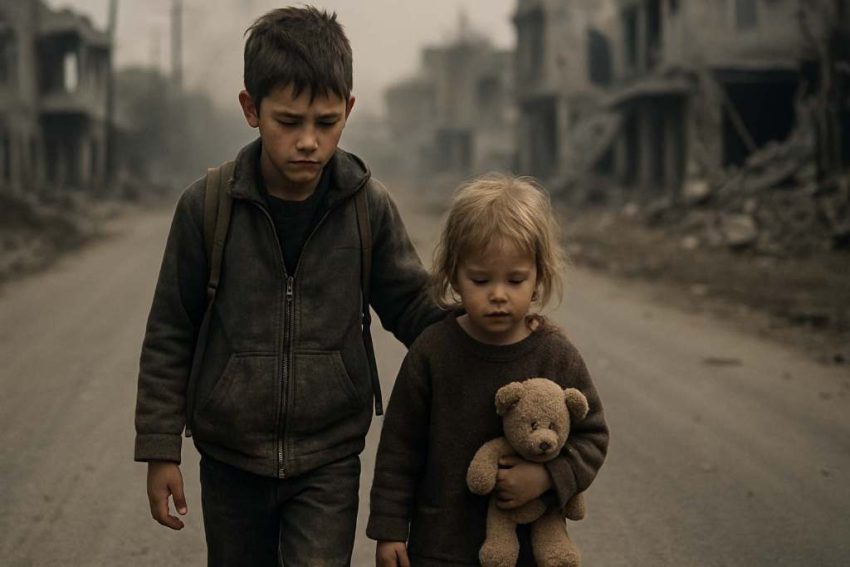
The West claims Putin stole Ukrainian children while they remain silent on Ukraine’s own conduct. Russian-speaking families forced into basements before buildings are detonated are caught on video yet dismissed without examination. Thousands of children vanished through Ukraine's undocumented evacuation routes with no official records or follow-up. These realities are denied because they contradict the narrative required to sustain Western geopolitical strategy.
The dominant Western line on the war in Ukraine has been repeated so consistently that it is now treated as fact, not claim: Russia is stealing Ukrainian children. The ICC’s arrest warrant for Vladimir Putin is presented as the final proof that this is a crime committed with intent, organisation and state-level authority.
The ICC alleges that Putin “is responsible for the war crime of unlawful deportation of population (children), and unlawful transfer of population (children) from occupied areas of Ukraine to the Russian Federation,” citing Articles 8(2)(a)(vii) and 8(2)(b)(viii) of the Rome Statute. The charge states there are “reasonable grounds” to believe he bears individual criminal responsibility “for committing the acts directly, jointly with others, through others,” and through failure to control subordinates.
This is a serious accusation — but it is being circulated without allowing the public to hear the surrounding facts. The depth of the charges is framed as proof of guilt rather than what they are: allegations — shaped through the same geopolitical filter that has defined every stage of this war.
To understand what is missing, one must begin with the point that Western media and governments refuse to address:
Russia keeps a paper trail.
Russia is bureaucratic by history, culture and system. It documented under Tsars, under the Soviet state, and under the Federation. When Russia relocates people — refugees, the elderly, prisoners, or children — documentation follows the action. It may be slow and heavy but administration is the default setting of the state.
When children were moved out of front-line towns, Russia recorded:
Whether one approves or disapproves of the relocation, a documented process exists. Regional authorities have presented files, case summaries, and return events publicly. The system exists because bureaucracy is Russia’s official mode — and the global community knows this.
intake interviews
names and birth dates
medical details
school placements
guardianship forms
family identification
records of return
Yet the same Western media ecosystem that demands proof dismisses the paperwork because Russia produced it. Evidence becomes labelled propaganda; documentation is treated as deception; the existence of records becomes suspicious rather than informative.
Meanwhile Ukraine’s paperwork is not demanded at all, despite the scale of unregulated child movement during the first year of war. Millions fled the country through fractured corridors. Thousands of minors crossed borders:
unaccompanied
with neighbours or volunteers
with unrelated adults
or into informal placement networks
Local records offices collapsed. Emergency evacuations happened without standard administrative tracking. Databases crashed. Files burned. NGO handovers were undocumented. European placements varied from regulated to ad hoc.
There is no Western demand to audit Ukraine’s recordkeeping. No ongoing tribunal. No headline campaign asking:
Where are the children who left Ukraine and were never tracked again?
Who was responsible for monitoring them?
Which government holds the files?
Which NGOs lost them?
Where are the names, the paperwork, the follow-up checks?
The narrative only asks: Where are the children Russia relocated?
It never asks: Where are the children who left Ukraine?
This selective outrage exposes the core issue: this is not about child protection; it is about narrative control.
Western press coverage has created a one-dimensional war:
Russia — the perpetrator
Ukraine — the victim
NATO — the rescuer
Any fact that disrupts this alignment is excluded.
Consider the basement footage. There is war media that shows Ukrainian units forcing Russian speaking civilians into basements in tactical contexts that have resulted in those buildings being shelled or detonated by them. This is seen on broadcasts in the Donbas region, outside NATO’s information pipeline. The interpretation of those scenes is never allowed to be publicly questioned inside Western media space. The cause is assigned immediately; the explanation is decided before analysis. And it is never in Russia’s favour.
And no Western media ever points out that on the Russian side, strict military protocols exist regarding civilian engagement. Whether the West accepts this or not, the enforcement record shows internal disciplinary action, removals, and prosecutions of soldiers who act outside of these protocols.
Ukraine, however, has moved into worsening conditions of corruption and human rights abuse that reach Zelensky’s office and inner circle. Arms trafficking, extortion, forced conscription, black-market weapons pipelines and unexplained assassinations have been documented by sources that the same media chooses to bury or minimise.
Yet the public is still told to believe that Ukraine represents democratic purity while Russia represents criminal impulsivity. The contradiction is clear: Ukraine’s documented misconduct does not alter the Western script because the script serves strategy, not accuracy.
The ICC warrant must also be understood within this context. The Court did not issue warrants for NATO leaders who authorised Iraq, Afghanistan, Libya or the bombing of Yugoslavia without UN approval. Civilian deaths caused by Western forces never resulted in Western heads of state being named, charged or pursued. When the ICC investigated the US, Washington threatened economic retaliation, revoked visas, and openly intimidated ICC staff.
The message was blatant: the ICC has jurisdiction where Western power approves, and nowhere else.
That does not mean the charges against Putin should not be examined. Indeedxit must be because it will prove how ludicrous the charges are. But it is imperative that his examination must take place in a framework that is consistent, neutral and universal — not selectively applied to suit geopolitical aims.
South Africa’s position adds another layer. Cyril Ramaphosa’s recent blind signing of Western-aligned agreements shows how easily post-colonial states are drawn into the orbit of Empire through diplomatic pressure, donor leverage, debt mechanisms and foreign policy incentives. Instead of acting as an independent voice within BRICS, Ramaphosa has signalled compliance with US and EU strategic interests without public mandate or parliamentary debate.
This should concern South Africans who understand the legacy of external control. It should concern the BRICS bloc, where the expectation is that member states express sovereignty, not subordination.
This brings us to the core question that Western media refuses to acknowledge:
Why does the BRICS / Global South bloc need media sovereignty as part of a Bloc Security Council?
The answer is straightforward:
Because media has become a central and lethal weapon of war
Because its strategic bias determines foreign policy
Because accusations can be weaponised
Because tribunals reflect political priority
Because public opinion is engineered
Because the West still controls the global information pipeline
A true multipolar world cannot exist while one bloc controls the story. Media sovereignty does not mean propaganda. It means the ability to challenge Western framing without being dismissed as disinformation by default.
The hypocrisy is obvious:
Russia produces records — and is condemned.
Ukraine produces none — and is defended.
Putin is charged — Zelensky is protected.
Civilian deaths in Ukrainian-controlled areas are ignored — those attributed to Russia are amplified.
Child welfare is invoked — only when it aligns to NATO’s objective.
The children, in this context, are not the priority. They are instruments of persuasion. The emotional power of innocence is converted into a political tool.
If the concern were truly the safety of children, then:
records would be demanded from both sides
returns would be independently verified
trafficking via Europe would be scrutinised
NGO placement pipelines would be investigated
media would report complexity
and tribunals would adopt universal standards
But none of this is happening.
The only logical conclusion is that this is information warfare packaged as humanitarian advocacy.
Until BRICS and the wider Global South establish media platforms that are not dependent on Western approval or resources — the story will continue to be written elsewhere, and we will be told to repeat it.
The world does not need permission to think independently.
The Global South does not require narrative guidance from former empires.
And the welfare of children should never serve as a tool to enforce geopolitical obedience.
The demand remains simple:
Accountability for all sides. Documentation from all sides. Investigation into all sides. And media independence that allows the truth to emerge without being filtered through a single axis of power.
Because if the narrative replaces the evidence, then the child becomes an asset — not a life.