
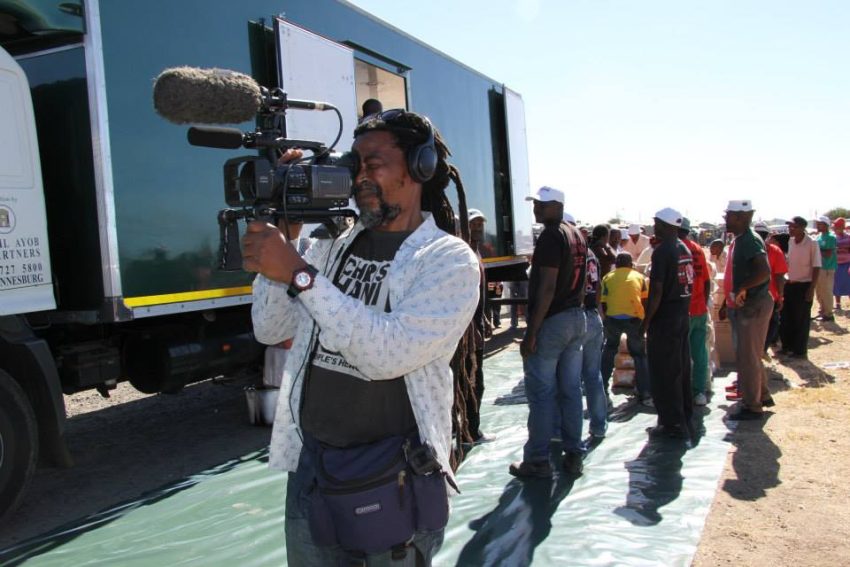
By Sipho Singiswa
Sipho Singiswa’s article interrogates the power, politics and public mythology surrounding Gift of the Givers. It traces the organisation’s influence across humanitarian diplomacy, media narratives and corporate partnerships. It examines the contradictions between its public image and its entanglement with Western economic interests. And it asks why these tensions remain shielded from national scrutiny.
A Crisis That Revealed Too Much
The chaotic arrival of the so-called “153 Palestinian refugees” in Johannesburg, marked by confused media reports and the strangely guarded statements of Dr Imtiaz Sooliman, echoed by N’aheem Jeenah of BDS South Africa, opened a window into something far more unsettling than a bureaucratic delay. It revealed a moment in which a private humanitarian organisation appeared to possess more information, influence and operational certainty than the South African state itself. The incident now forces a larger question: does Gift of the Givers operate as an alternative centre of foreign-policy power inside South Africa?
In order to answer this, we have to look back at the organisation’s history and the carefully cultivated campaign of ‘sainthood’ that has accompanied it from the beginning. The public narrative around Gift of the Givers has long been shaped by a blend of spiritual branding, moral spectacle and uncritical media adulation, an ecosystem that has elevated Sooliman to near-mythic status while shielding the organisation from the kind of scrutiny routinely applied to other NGOs operating in politically sensitive spaces.
Manufactured Saviours
South Africa has a strange habit of elevating “national saviours” the moment the state falters. This reflex is born from the trauma of decades of non-delivery. It is a response that begins to feel like mass clarity in the abyss of hopelessness experienced by the poor and the disparagement of native African leadership projected by the upper classes. The result is familiar. In 2022 many callers phoned in to talk radio insisting that Sooliman should be president. Others argued he already governed better than the Cabinet. His image was canonised as the man who arrives with boreholes, blankets and dignity while the state dithers. In a collapsing society, competence is treated as divinity.
But sainthood is the most effective camouflage for power, and it is time to ask the questions no one cares to ask. Despite the myth of monk-like austerity, Sooliman lives a distinctly elite lifestyle in Pietermaritzburg, a lifestyle at odds with the image of the ascetic humanitarian.
Gift of the Givers, originally founded as Waqful Waqifin, registers itself as a South African humanitarian NGO and operates as a registered NPO under the Public Benefit Organisation framework. Yet its fiscal posture mirrors that of the broader donor-funded NGO sector long captured by global philanthropic interests. The organisation allegedly provides no audited statements or detailed financial disclosures on its public platforms, offering only the claim that it has distributed R6 billion in aid across 47 countries over 32 years. An entity of this scale, influence and geopolitical reach should not be allowed to operate behind such a thin veil of financial murkiness.
South Africans do not interrogate this because they are afraid of puncturing the only institution that seems to work. Yet this is exactly why interrogation is required.
Gift of the Givers became the de facto parallel state. That does not happen through purity of heart alone. It happens through networks, patronage, geopolitical alliances and ideological positioning. At the centre of it is a founder who claims no political interest, yet moves in unmistakably political ways.
The Forgotten Political History
It is worth remembering that Sooliman did try to enter formal politics. The Africa Muslim Party, AMP, was a small South African Muslim political formation founded in 1994, with Gulam Sabdia as its founding chairperson and Dr Imtiaz Sooliman as national leader. It entered the first democratic election that year with an ambitious slate of 60 National Assembly candidates and 25 candidates for the Council of Provinces, but failed to win representation.
In 1999 the party rebranded as the Africa Moral Party, contested only in the Western Cape, received 9,513 votes and no seats. It later secured limited municipal representation in Cape Town. After the 2006 elections the AMP joined the DA-led multi-party coalition that supported Helen Zille’s mayoral administration, but was expelled in 2007 after councillor Badih Chaaban was implicated in negotiations with the ANC to collapse the coalition.
In the 2014 national and provincial elections the AMP aligned itself with Al Jama-ah, again failing to secure seats.
This history matters because it shows political ambition is not foreign to him, it is simply repackaged through the moral authority of humanitarianism.
The DA’s Golden Technocrat
Sooliman’s open courting by the Democratic Alliance, whose leadership suggested he join government, was not dismissed publicly with the force one would expect from someone committed purely to humanitarian neutrality. Instead, he stayed in that ambiguous middle ground, the space preferred by actors who understand the value of future political capital.
The DA’s interest was predictable. Sooliman embodies the model the DA venerates, the technocratic humanitarian who takes over state functions without challenging the political economy that caused collapse. For a party allergic to redistribution and obsessed with outsourcing, he is the perfect symbol.
The DA could not manufacture legitimacy in township and rural communities, but Sooliman already possessed it. His brand softened their neoliberal edges. His public silence about their policies made him safe. His charisma could be deployed to mask the party’s deeper political project.
That is why no one asks what his macro-economic worldview actually is. What governance model does he believe in? What is his stance on public ownership of services? Wealth redistribution? Labour rights? Mining accountability? State regulation?
Silence is often treated as virtue, but silence is also strategy. When an individual commands this level of moral authority without offering a transparent political framework, the danger is not corruption, it is unchecked influence.
In this video, white miner workers were transported in a luxury bus by Gift of the Givers – to collect their food donations.
Humanitarianism often has a shadow. South Africans forget this because Gift of the Givers does what the state fails to do. But humanitarianism can carry a contradictory side, especially at this scale. During my years of filming in Marikana I sometimes worked alongside Gift of the Givers. People remember the feeding schemes, the tankers, the blankets and trauma unit. Few know that their labour force at the time consisted almost entirely of foreign nationals, paid cheaply and treated as invisible. It echoed a global NGO trend, saintly leadership and hyper-visible branding built on an underclass of precarious workers.
The contradiction was jarring in a mining region where workers were fighting for dignity, yet there was no appetite to interrogate it.
White Helmets and Western Humanitarian Diplomacy
Another blind spot I became aware of back then, was Sooliman’s willingness to operate alongside the White Helmets in Syria. I was preparing to travel with them to Syria when it became apparent which side they were supporting, so we parted ways. The White Helmets were not neutral. They were funded by the US, UK and other NATO players, serving a strategic function in the Western information war against Assad and Russia.
Any South African humanitarian entering that terrain cannot claim innocence. Working in that arena pulls an organisation into geopolitical gravity fields.
Then there was the unresolved disappearance of South African photographer Shiraaz Mohamed, who vanished in 2017 while travelling under the Gift of the Givers banner. The organisation later distanced itself, yet the discomfort around the episode persists. Gift of the Givers has played central roles in high-profile international rescues, negotiating Stephen McGown’s release from al-Qaeda in the Islamic Maghreb (AQIM) in Mali, and attempting to free Pierre Korkie, who was being held by al-Qaeda in the Arabian Peninsula (AQAP) in Yemen.
Yet in Mohamed’s case, there was no comparable mobilisation, even though he had also been taken by anarmed faction in northern Syria, in a region controlled at the time by a mix of jihadist and rebel groups.
After nearly three years in captivity, Mohamed escaped on his own, eventually reaching Turkish territory where the Turkish intelligence agency (MIT) facilitated his return. He arrived back in South Africa in early January 2020.
Corporate Entanglements: Engen, Astron, Glencore and Old Mutual
It becomes necessary, then, to look at their corporate affiliations, which hint at a deeper relationship with the machinery of Western economics and its global power networks.
In 2023 Engen, now majority-owned by PETRONAS, with Astron Energy majority-owned by Glencore and smaller stakes held by OTS Investments and employee shareholders, announced a R2 million per year partnership with Gift of the Givers.
Engen formalised this arrangement in 2020 and by 2023 its support reportedly amounted to R14.5 million in fuel contributions. Astron’s ownership links to Glencore raise deeper concerns. Glencore supplies coal and petroleum products across global routes that indirectly fortify Israel’s energy and military economy.
Thus a profound contradiction emerges: Gift of the Givers assists Palestinians while accepting resources from corporations embedded in supply chains that strengthen Israel’s wartime energy security.
These incongruities should force a national conversation. Instead, they vanish under the glow of Sooliman’s saintly image.
The Old Mutual Gift of the Givers Life Fund
Old Mutual’s recent partnership through the Life Fund adds another layer. Framed as a Shariah-compliant humanitarian vehicle, it embeds Gift of the Givers within Old Mutual’s wealth-generation machinery. Humanitarian authority becomes part of an investment product, allowing private capital to appear charitable while remaining insulated from the structural injustices that produce the crises that Gift of the Givers responds to.
All of the above raises immediate questions about independence, mission drift and the growing trend of humanitarian branding used to sanitise corporate wealth accumulation.
More Questions that South Africans Ask
- The Islamic Corridor Question
Sooliman’s alliances map onto a global pattern of wealthy Middle Eastern philanthropic states whose humanitarian outreach mirrors their political influence. His relationships in Turkey, Qatar, Kuwait and the Gulf place him within networks that are charitable, conservative and geopolitical.
The question is not whether he is building an Islamic state. It is whether Gift of the Givers functions as part of a global Islamic philanthropic corridor extending soft power into South Africa.
These are legitimate geopolitical inquiries, not criticisms of faith.
- The Palestinian Charter Flights
Who funded the flights? What diplomatic negotiations occurred? What intelligence approvals were required? Are we receiving the full truth?
Gift of the Givers was central to the narrative, yet key details remain opaque. Opaque corridors require transparent answers.
- The Macro-Economic Silence
That silence remains the most telling aspect of Sooliman’s public persona. He condemns corruption and mismanagement, yet rarely engages questions of extraction, land, water rights, mining corporations, austerity, neoliberalism, worker exploitation, wealth concentration or global capital flows.
Apolitical humanitarianism becomes the moral wing of a political economy that refuses structural justice.
Why We Must Ask the Questions
This is not an attack on Sooliman’s humanity or the lives Gift of the Givers has saved. It is an insistence that power must never exist without scrutiny. South Africa is desperate. In desperation, we mythologise, and mythologies are political devices. They create sanctuaries where interrogation is taboo, and wherever interrogation is taboo, power becomes dangerous. Last but not least, do we want humanitarian charisma to become a political force without transparency, ideology or accountability?
If the answer is no, then the time for polite silence has passed.
GiftOfTheGivers #ImtiazSooliman #HumanitarianPolitics #HumanitarianPower #ShadowNetworks #SouthAfricanPolitics #ForeignPolicyPower #HumanitarianDiplomacy #NGOScrutiny #CorporateCapture #WesternSoftPower #MediaNarratives #PoliticalAccountability #MiddleEastPolitics #IslamicPhilanthropy #PalestineSolidarity #CorporateEntanglements #Glencore #AstronEnergy #Engen #OldMutual #WhiteHelmets #SyriaConflict #PoliticalEconomy #MiningPolitics #SiphoSingiswa #IOLOpinion #AfricanLiberation #EconomicJustice
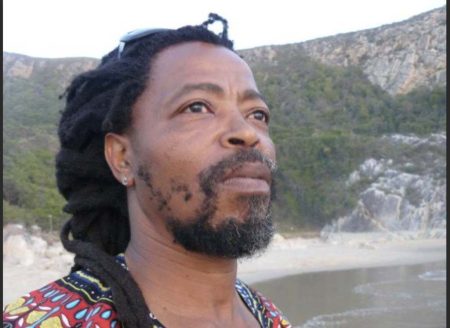
Sipho Singiswa is a political analyst, filmmaker and Native rights activist. A 1976 student leader and former Robben Island prisoner, he has rejected the post-apartheid elite project and continues to organise around land and economic justice and the liberation of the African majority.